

Some photographs begin with a location. Others begin with a model, a piece of wardrobe, or an idea that refuses to leave your head.
Fallen began with a pair of wings.
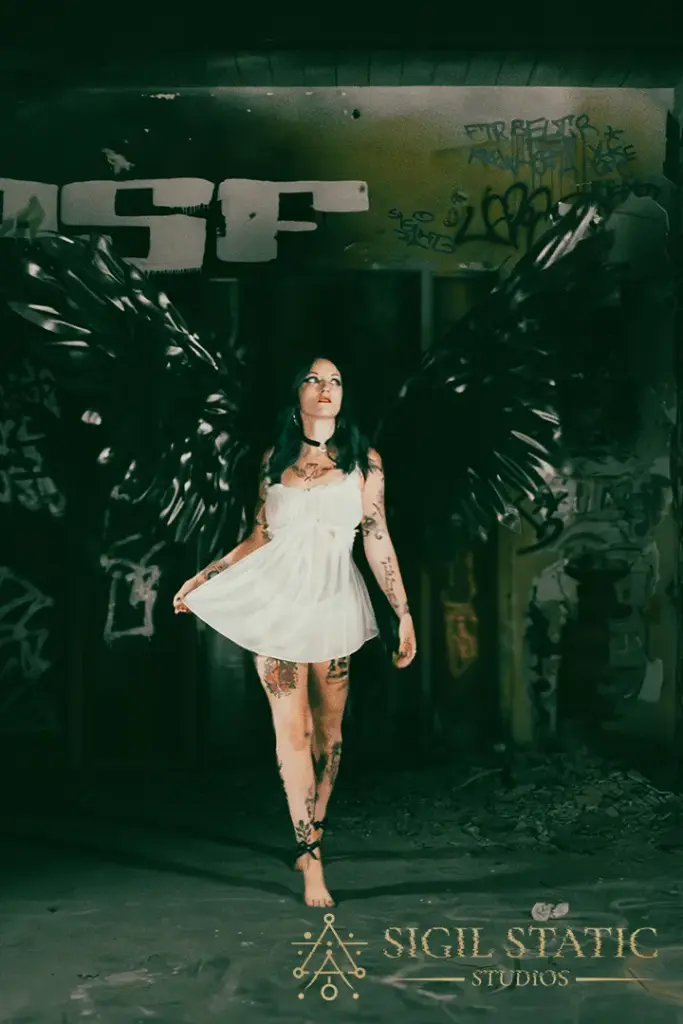
Not small costume-store angel wings, either. These were enormous black feathered wings, dramatic enough that the moment you saw them, they demanded a photograph worthy of them. They had been handmade by a creator in Ukraine, and purchased for me as a birthday gift by my partner, Denise.
Even before they appeared in front of the camera, then, they had a story.
The question was what to do with them.
Finding a Home for a Fallen Angel
There are certain combinations that almost design themselves.
Black wings against a seamless studio backdrop could certainly have worked, but it would have made the wings the spectacle. I wanted something that gave them context. I wanted the person wearing them to appear as though she belonged to a world where those wings made sense.
Stone Hill Farm near Maple Bay immediately came to mind.
I’d photographed there before, including Crescent & Steel and Veil of Shadows, and what makes the property visually compelling is its state of decay. Abandoned structures, graffiti, exposed surfaces and the slow reclamation of human spaces by weather and time give you layers that simply don’t exist on a studio backdrop.
For Fallen, we used the abandoned mansion.
The contrast was exactly what I wanted: these enormous black wings surrounded not by clouds, cathedrals or some obvious approximation of heaven and hell, but by the remains of something distinctly human.
Then there was Kyra.
I’ve photographed Kyra repeatedly, and that existing creative relationship matters on a shoot like this. When you’re asking someone to stand inside an abandoned building wearing a massive pair of black wings while you experiment with composition, wardrobe and location, familiarity makes the process considerably easier.
More importantly, Kyra could carry the visual weight of the concept without disappearing beneath it.
With props this dramatic, that’s a legitimate danger.
The photograph can become look at these incredible wings, with the model reduced to the mechanism holding them upright.
I wanted a person with wings.
Not wings with a person attached.
Angel, Demon or Something In Between?
One thing I deliberately didn’t want to establish was exactly what Kyra’s character was supposed to be.
The obvious answer is a fallen angel. The title certainly points in that direction.
But fallen from where?
And why?
Religious and mythological traditions have given us centuries of imagery in which wings immediately communicate meaning. White wings suggest purity, divinity and innocence. Black wings tend to push us toward corruption, exile, death or rebellion.
Those associations are useful because a photographer can exploit them without necessarily accepting them.
Kyra’s blue hair, tattoos and contemporary clothing make no attempt to create a historically convincing angel. Neither does the graffiti surrounding her. There is no effort to conceal the modern world.
Instead, the photographs collide those things deliberately.
The wings suggest mythology.
The building suggests collapse.
Kyra remains unmistakably contemporary.
That leaves the viewer to fill in the space between them.
Maybe she has fallen.
Maybe she has been cast out.
Maybe she belongs there.
Or maybe we’ve simply been trained by centuries of imagery to look at black wings and assume something terrible must have happened.
I like photographs that leave enough unanswered for the viewer to participate.
Fallen didn’t need lore.
It needed possibility.
Photographing Scale
The practical problem with enormous wings is that they are, inconveniently, enormous. So enormous, in fact, I could not reasonably fit them in the trunk of my 2019 Nissan Kicks. Instead, they took up valuable seating real estate in the back seat, gently folded over and ready to be unfolded on arrival.
Ollie Henderson joined us for the shoot, handling Kyra’s makeup and documenting parts of the day behind the scenes. By this point, Ollie had become a regular part of the creative process, and having another set of hands—and another creative eye—was particularly useful on a shoot involving a location this unpredictable and a pair of wings this unwieldy.
Some of the behind-the-scenes photographs accompanying this article are hers, offering another perspective on what was happening outside my own frame.
Portrait photography usually gives you fairly predictable boundaries. You’re composing around a human body. Once you attach a massive horizontal and vertical element to that body, your relationship with the frame changes.
Suddenly the negative space matters differently.
Doorways become both useful framing devices, and annoying obstacles. Walls can either contain the wings or compete with them. Ceilings and hallways suffocate. Moving closer gives the model greater presence but sacrifices the scale of the prop. Moving backward reveals the wings but risks allowing the environment to overwhelm the subject.
That became one of the central compositional problems of Fallen: deciding when the photograph was about Kyra and when it was about Kyra’s relationship with the space around her.
The abandoned mansion helped because it offered both.
Some frames could use the architecture almost as a stage, allowing the wings to spread against graffiti and ruined surfaces. Others could move closer, letting feathers become texture rather than simply silhouette.
The wings also changed Kyra’s physical presence.
Put something that large on someone’s back and even a relatively simple pose becomes theatrical. Small shifts in posture change whether the wings appear protective, threatening, wounded or triumphant.
There was no need to manufacture a tremendous amount of action.
Sometimes simply standing there was enough.
The Ruins Became Part of the Character
I’ve always been interested in locations that bring something of their own to a photograph. This has been clear with my repeated visits to Stone Hill Farms, the Stone Butter Church, and my obsession with abandoned places.
A neutral environment gives you control. An abandoned environment gives you arguments.
There are lines you didn’t put there. Colours you didn’t choose. Graffiti competing for attention. Broken architecture interrupting compositions. Light entering from places that may be useful in one frame and infuriating in the next.
But those imperfections were precisely what Fallen needed.
The location carries evidence of something that existed before and has since deteriorated. Against that, Kyra’s wings introduce another kind of implied history.
Both suggest a before and an after.
Neither tells us what happened between them.
That’s where one of the central themes of the project began to emerge for me: transition.
Ruins are transitional spaces even when they appear static. They are caught between what they were and whatever they will eventually become. A fallen figure carries the same implication. Falling is not really an identity. It is an event between one state and another.
Which made something else about this shoot unexpectedly appropriate.
The Last Shoot With My Canon T7
Fallen became the final project I photographed with my Canon EOS T7 before upgrading to the Canon R50.
I didn’t originally conceive the project as some ceremonial farewell to the camera. There was no dramatic moment where I looked down at the T7 and whispered, one last ride.
But in retrospect, the timing gives the series another layer.
That camera had been responsible for an enormous amount of my photographic development. You learn the fundamentals with whatever equipment you have in your hands, and over time you learn not only what that equipment can do but exactly where it begins pushing back.
You learn its tolerances.
You learn how far you can push an exposure. You learn what happens when the light isn’t there. You learn which problems can be solved in post and which ones should have been solved before pressing the shutter.
Eventually, if you’re fortunate, you reach the point where your equipment isn’t teaching you what it can do anymore.
It’s teaching you what you want to do next.
The R50 represents that next stage for me, but I don’t think that diminishes what came before it.
Quite the opposite.
Fallen feels like an appropriate final project for the T7 precisely because the photographs are so concerned with transition.
Something ends.
Something else begins.
The Story Behind the Wings
There is one detail I keep returning to when I look at these photographs.
Those wings travelled a long way before they reached an abandoned mansion on Vancouver Island.
They were handmade by a creator in Uzhhorod, in a country living through war, purchased by Denise, shipped across continents and eventually strapped onto Kyra’s back while I stood in the ruins with a camera.
Photography has a strange ability to collect unrelated histories inside a single frame.
The person who made the wings wasn’t standing beside me when I took the photograph. Denise isn’t visible in the finished image. The journey from Ukraine to British Columbia cannot be seen in the feathers.
But all of those things are still part of the photograph’s existence.
That’s different from saying the photographs are about Ukraine or war. They aren’t, and I wouldn’t want to appropriate somebody else’s reality to manufacture meaning that wasn’t part of the original concept.
But knowing where the wings came from changes my relationship with them.
They are not disposable props.
Someone made them. Someone I love gave them to me. Someone I trust creatively wore them.
And together we turned them into something none of those people could have made independently.
That collaborative chain matters to me.
What Fallen Became
I went into Fallen wanting to photograph Kyra wearing a spectacular pair of black wings in a location capable of supporting their visual weight.
I came away with something more transitional than I expected.
It became a project about grace without purity, darkness without inherent evil, and ruins that don’t necessarily represent endings.
It became a project about ambiguity.
And, unintentionally, it became a marker in my own development as a photographer.
The last conceptual series photographed with one camera before moving to another.
One location slowly becoming something other than what it once was.
One handmade object travelling halfway around the world before becoming part of somebody else’s artwork.
One figure standing among the remains with her wings still attached.
Maybe that’s ultimately why the title works for me.
Falling and failing aren’t synonyms.
To fall only tells us that something has left where it was.
It tells us nothing about where it will land.
And not everything that falls is lost.